Posts Tagged ‘Sustainable living’

24
Jun

The hard long ride – Entry #173

   Posted by: trobinson    in Sustainable living

Last week during the NW Vineyard conference at our church a man approached me that I had known from years before. He told me he had a vivid dream the night before. He seemed a bit uneasy and unsettled yet resolved to share what he had seen. He told me that in his dream he had seen me riding a horse at top speed holding up a lantern like Paul Revere. He said that the horse showed signs of being ridden hard as a result of carrying me from place to place as I shouted an alarm of urgent warning. That was the entirety of the dream and he wasn’t sure what it all meant. Somehow he was sure that it was very significant. I thanked him, and in the confusion of the moment returned to my responsibilities of hosting the large gathering at the conference.

 It was nearly a week later before I had a chance to sit down and quietly reflect on all that had happened at the conference as well as the significance of the dream. Nancy’s and my life had been a whirlwind for several weeks as we not only prepared for and hosted the conference of several hundred Christian leaders, but the week before we had celebrated the wedding of our son. (see entry #171.)  

 This morning as I sat in the solitude of our living room praying I was reminded of the dream I was given. Being a pastor that believes in supernatural revelation it’s not unusual for me to receive prophecies, dreams and visions from all kinds of people. Through the years I have observed that much of the prophetic revelation I hear comes to nothing, while some have been amazingly and divinely fulfilled. I’ve learned to sort out true revelation from human expectation by simply taking the words I hear before God in prayer. All this to say that as I prayed about it today, I realized this man’s dream spoke of my life’s quest over the past twelve years to sound an alarm for harder times coming. It echoed the passion I have felt for Christian believers to live more sustainable lifestyles. To be honest I didn’t even know what “sustainable living” meant or encompassed twelve years ago. It was a phrase that hadn’t been widely used before the year 2000. Yet, in 1998 I felt compelled to preach a message to our church warning any that would listen to prepare for the harder days that were to come. Y2K was first being talked about then. Although I didn’t want to be an alarmist I distinctly remember feeling preparation was somehow crucial; not just for that year, but as a new long term lifestyle. I had been afraid of being seen as a fanatic and knew that if I said anything about the potential of the harder days I saw coming many would push back and possibly even leave the church. I fought the temptation to say nothing and carry on with a less provocative and more palatable messages, yet I felt the conviction of the Lord to push through my fears. I began challenging people to get out of financial debt and learn new skills (actually old skills that had been forgotten) of becoming less dependent on commercialized food, energy and water sources. I exhorted them not to simply store food, but to learn the skills of growing and preserving food. I told them that this was not only important for the sake of having food to eat and share with others in need, but also it was about having a more healthy organic choice. Read the rest of this entry »

Tags: , , ,

7
Jun

A celebration of blessing- Entry #171

   Posted by: trobinson    in Country living reflections

When I built the horse barn I hadn’t dreamt it would one day become the place that we would host a rehearsal dinner party to celebrate the wedding of our son Brook and new daughter Andrea.  Last Friday evening however, over fifty people sat down to eat a wonderful meal together while a live Bluegrass band played in the hayloft above. 

A few months before when Brook asked about the possibility of using the barn for such an occasion we naturally jumped at the idea.  We hadn’t guessed at the time that June would be one of the wettest in recent history.  Literally an hour before the party started on Friday evening a lightning storm blew through bringing with it not only the crashing of thunder but a torrential downpour of driving rain.  I also hadn’t considered the idea that the invitation list might grow at the last minute to be more folks than our four horse barn

The High Desert Bluegrass Band

could possibly accommodate.  The fact of the matter was, we were all so excited for the occasion our enthusiasm would override any obstruction.  We were blessed to be asked and started to plan the event right away.  Nancy figured out the food and I started to clean out the barn. With some great help I shoveled out a mountain of manure which had been accumulating all winter and even painted all of the interior walls. (See entry’s #167 & 162)  The day of the dinner we had fun doing the finish work with some wonderful old friends who have known and loved our kids for years.   We covered the floor with wood shavings, set up tables and decorated them.  In the end nearly sixty people comfortably sat down to the BBQ dinner.  

Rand Thompson and the High Desert Bluegrass Band set up in the hayloft and played through-out the entire evening.  Not only did the night turn out to be a joyous celebration, but the rain and wind moved on leaving behind only the cool fresh smell of spring in the air.  When the evening ended we all recognized that God had blessed the night and the marriage covenant which was about to be made between Brook and his beautiful bride Andrea.

Tags: , , , , ,

Our scarecrow shivered during the end of May

When people live close to the land and even depend on it for the substance of life they become acutely aware of change.  For years Nancy and I have planted our garden in mid May. Not the frail things like tomatoes and peppers, but the early crops like potatoes and peas.  This year was a bit different – the fruit trees had already budded and blossomed.  The potato plants were six inches tall in the garden and the alfalfa had been growing in leaps and bounds over the past month even though it had been wet and unseasonably cold.  Everything was on schedule until a late unexpected snow storm dumped two fresh inches of snow on the ground and the temperatures plummeted to below freezing during the night.  As a result, this year’s fruit will be lost for the second year, the potatoes died back and even some of the alfalfa froze in the field.  It was crazy. 

As soon as the snow started to fall I scrambled to get Nancy’s vegetable starts which she had set out to harden for planting back into the greenhouse.   We knew that the spring seems to extend longer year by year, but to get a freezing snowfall a couple of weeks before it is officially summer seemed outlandish.  Talking to my neighbor, Craig Krosch, who has farmed the Timber Butte area for years, he said he is confident that the weather changes here are not just a fluke, but very real. For three years now he has lost dry-land alfalfa to hard frost a month before it was to be harvested. I didn’t even know such a thing could happen, but then I’m a rookie compared to him.  

New potatoes peeking through fresh snow

Folks everywhere are denying that “Global Warming” is really happening, not understanding that it will manifest itself in different ways in different regions.  I personally believe that the term “Global Warming” challenges a debate as to if the changes are human caused or naturally caused.  Personally I feel that debate distracts from the fact that the climate is changing and farmers especially are and will be facing grave new challenges.  No one can deny that hurricanes, tornadoes and disastrous flooding are on the increase in both quantity and intensity nationwide for whatever reason. Meteorologists are alerting us that because the Atlantic Ocean waters are the warmest they have been in recorded history they may well cause another bad year for hurricanes in the southern coastal regions.

Blossoms on a snowy morning

As human beings we hate to admit that things are changing, especially for the worst.  By nature we hate change and we secretly want everything to stay the same.  The Apostle Paul once wrote about this when he was speaking about the changes that would occur right before the second coming of Christ.  He said, “Most importantly, I want to remind you that in the last days scoffers will come, mocking the truth and following their own desires. They will say, “What happened to the promise that Jesus is coming again? From before the times of our ancestors, everything has remained the same since the world was first created.”

 I, for one, don’t want to find myself in that camp; I’d rather admit things are changing and try to deal with it as best as I can. Next year we’ll wait a few weeks before we put our garden in.

Tags: , , , , , , ,

12
May

Second chance bees – Entry #166

   Posted by: trobinson    in Beekeeping

We were heartbroken last March when I discovered that our first colony of honey bees had abandoned their hive.  It had been our first experience raising bees and we had been elated at the plentiful harvest we experienced at the end of a first season.  Our industrious bees had filled two supers with harvestable honey after storing away two main boxes which would be an ample amount to sustain them through the coming winter.  It’s hard to explain the fealings of depression we felt, (unless you have had the chance to raise bees yourself) but we had actually built a kind of relationship with them.  Even before winter began I felt a type of parental concern worrying about their welfare as days become shorter and colder.  I knew that they had plenty of stored honey to get them through the cold months ahead, but felt concern for the bitter cold subzero temperatures they would be facing.  I looked on the web in hope of discovering how to winterize the hive and even asked for advice from folks who had far more experience than me, yet I still felt uncertain.  

Annual Bee clinic in Fruitland, Idaho

In an effort to protect them from the cold north winds I built a protective wall of hay around three sides of the hive leaving the sunny south facing side open.  I also fashioned a sheet of roofing steel over the top to keep the driving rains from saturating them and the deep snows from burying them.  In my mind I couldn’t understand how zero temperatures wouldn’t freeze the little guys into a solid block along with their stored honey supply when they were merely protected by a thin walled wooden box.  After tucking them in the best I knew how I left the hive alone until March when I decided to put my ear to the cover lid in hope of hearing the buzzing sounds of life.  I didn’t – the hive seemed empty. 

Nancy behind the veil

I had heard reports from our bee keeping friend Mike Lutz and a neighbor down the road who both had lost their bees to what they considered to be hive collapse syndrome or disorder and so I decided to have a look.  Carefully prying up the lid I looked in only to discover they too had disappeared.  I felt a little heartbroken and really discouraged but after discussing it with Nancy decided not to give up but to try again the following spring.

Every year there is a beekeeping clinic offered in Fruitland, Idaho on the first of May for folks like us who are complete rookies when it comes to bees.  I had attended the clinic the year before and purchased our first colony.  This year I asked Nancy to go along with me hopeful that between the two of us we could ask more questions and retain more information. 

 The week before the clinic was scheduled I decided to empty the old hives and prepare them for the new colonies we would be bringing home. We decided to try two hives side by side after hearing that bee colonies do best in partnership. Opening the hive and pulling the old frames I discovered the abandoned combs were loaded with several gallons of honey. I couldn’t understand why a seemingly healthy bunch of bees would leave such a gold mine in the middle of winter. As I removed the last frames from the bottom box I discovered a dead mouse and a nest right in the middle. I wondered then if the mouse was the reason for the bee’s evacuation or if he had moved in after the bees had already left.  I had no idea. 

The new bees come home

At the clinic I shared my finding with an experienced bee keeper and he told me it was common for mice to run off bees in winter when the bees are too weak to fight for their hive.  He said that by pilling hay around the hive I had actually provided a good habitat for the mice and had even encouraged them to take up residence around their hive. He also told me that I could fashion a mouse guard made out of a piece of angle iron with holes drilled in it and fasten it in front of the hive entrance.  The holes are large enough for bees to enter and exit but would keep the mice out.

Learning is a lifelong process I’ve discovered and many if not most lessons learned seem to come by way of failures and mistakes.  I was tempted to give up on our beekeeping venture after my first failed attempt, but with Nancy’s encouragement decided to try again.  We now have two new hives full of buzzing bees in our vegetable garden where we are able to watch them daily.  They are already getting established and making themselves at home enjoying the first blossoms of spring.

Tags: , , , , , ,

Our new book now released by Baker Book Publishing

Last week Baker Books officially released Rooted in Good Soil, a book that I had labored over for nearly a year. It tells the story in a rather unusual way of what I would call the organic Christian journey to maturity and fruitfulness. At the same time as the book was released I was invited to spend three days with some pastor couples and leaders at a retreat center in the heart of Montana. Most of them are old friends who have been faithfully serving in cities and rural towns of Montana for years. They are special people who Nancy and I have grown to love but haven’t had the chance to spend time with for a long time. They asked me to come teach the new things God had been doing through our ministry and the books I have been writing.  As I prepared for what I believed would be a rich time of renewing old relationships it was in my heart to be a blessing in their lives if possible with my short visit.

While driving to the airport early in the morning to catch my plane I prayed and asked the Lord for a fresh message that would be both helpful and relevant not only for the ministries they lead but for their individual lives as well. I was weaving down the canyon road out of our hills towards the interstate just as the early morning light was breaking over the distant eastern mountains. As I prayed I began to hum an old children’s song I once sang as a young boy in Sunday school some fifty years before. At first I couldn’t recall the words, but gradually a few of them started to come to memory and I sang what I could remember with a hope that others would follow; but they didn’t. I sang, “Deep and wide, deep and wide, there is a fountain flowing deep and wide.” I sang this one stanza over and over again straining for the remaining lyrics.  I felt certain that if I could recall the words the Lord would use them to show me what it was he wanted me to relate to the Montana pastors. Finally giving up, I called Nancy on my cell phone and ask her to Google the old song on her computer and call me back later with her findings. It wasn’t until I had arrived at the Boise airport and checked through security that Nancy’s return call came informing me that she had in fact succeeded finding the old song but that there were no additional lyrics. The entirety of the song was, “Deep and wide, deep and wide, there’s a fountain flowing deep and wide”. That was all there was to it. My first response was disappointment; I was totally bummed and concluded that I hadn’t heard the Lord at all until it struck me that this was the message – “deep and wide”.  I was to tell the pastors to go deep and wide and to lead the folks in their churches deep and wide. I know this may sound crazy to many, but in reality there is no greater thing for a Christian to do than to go deep with God for the sake of taking his love and ministry wide. I recalled how I had been hearing so much talk recently concerning the church in America being an inch deep and a mile wide; how that if the truth be known it may not even be a mile wide. This would be especially true if you define the “width” to be more about community and worldwide impact rather than the number of people in attendance on any given Sunday.

When Jesus was asked what was the greatest commandment he said, “Love the Lord your God with all your heart and with all your soul and with all your mind. He said this is the first and greatest commandment and the second is like it: “Love your neighbor as yourself.” (Matt. 22:37) Learning to love God and to be loved by him is the essence of going deep. Deep Christianity calls for a deep relationship with God. Learning to unconditionally love your neighbor, (especially the non-churched and the poor) is the essence of going wide. As simple as it might seem, to go both deep and wide (and in that order) is the key to authentic Christian faith. I’m convinced it is what God desires and is saying to his people. 

After returning home from my short trip to Montana this simple thought stayed with me. It was in my mind even two days later as I worked up the enriched soil in the garden, forming raised beds and preparing a drip line irrigation system to water the seeds Nancy would soon be planting. I turned the soil over several times as I formed the rows; the first time to break up the compacted ground, and a second time to work in new compost and seasoned manure. Every vegetable gardener knows that the most critical issue in helping a plant to grow to fruitfulness is in the preparation of soil. For the plant to grow tall and wide its roots must first grow deep into the richness of the fertile ground. Establishing deep roots is everything for a healthy plant just as becoming deeply rooted in God’s love is everything for the Christian that wants to experience lasting spiritual maturity. The Apostle Paul once prayed, “I pray that you, being rooted and established in love, may have power, together with all the saints, to grasp how wide and long and high and deep is the love of Christ, and to know this love that surpasses knowledge—that you may be filled to the measure of all the fullness of God.”(Eph. 3:18) It is being filled with the “fullness of God” that enables us to not only grasp the love of God, but to take it wide; to take it to a pain-filled and broken world in very real and tangible ways.

Recalling those few words from a childhood song and overlaying them on the heart of the new book I had recently written encouraged and excited me as I got to see my old friends again.  I knew God wanted to do a special thing for them, and that through the sincerity of their lives he would somehow impact the state of Montana.

Tags: , , , , , , ,

12
Apr

Planting a vineyard – Entry #160

   Posted by: trobinson    in Agriculture

It always seems to me that the more you learn about something the more you realize you don’t know. Preparing to plant our first vineyard at Timber Butte has been another one of those humbling experiences.  Over a year ago I decided to prepare a series of terraces adjacent to our root cellar for a future vineyard (see entry #106). I realized at the time that we knew nothing of grapes and vineyards except for the fact that they needed plenty of sun to thrive.  Just as the many things we have been learning to do at Timber Butte Homestead, I decided to cross the “vintner” bridge when I came to it – which I figured would be the following spring.  As always, time flies and the following spring has now sprung upon us so Nancy and I took a two day road trip to central Washington to visit “Inland Desert Nursery.”  We went there to buy grapevines and get a few basic pointers from a real vintner named Tom Judkins. Our experience was far beyond our expectations.

The five hour drive to Inland Desert Nursery was worth the effort

 Nancy had called ahead and shared our need with Tom’s son Jerry who was more than helpful, especially considering the size of our order. Taking into account our elevation and climatic zone as well as our desire to grow both table and wine grapes Jerry suggested the hardiest varieties for our area. After their short conversation we concluded it would be worth our while to make the five hour drive to pick up our small order so we could get a little more firsthand instruction on planting and care.  Inland Desert Nursery generally only deals with larger commercial operations but was willing to sell us just thirty bare root vines.

Following our GPS we were led several miles out of Benton, Washington through acres of vineyards and fruit orchards until we were told by the mechanical British voice on the GPS (we fondly refer to as Roger) that we had reached our destination on a dirt road in the middle of a vineyard.  There wasn’t a building in sight.  After a quick phone call Tom Judkins’ daughter Kim guided us to a series of structures where dozens of workers were industriously preparing what looked to be hundreds of large commercial orders for the spring planting.  In the scheme of things we felt really insignificant knowing how small our order had been. 

Our friend Sally from England volunteered to help plant the terraces with our new vines

 The morning air was cold and breezy as we stepped out of our car and I think we must have looked a little disorientated as we tried to figure out where to go and who to talk to. It was then that a kind Hispanic lady approached us and asked us if we were there to pick up an order. Realizing our confusion she led us into a nearby green house where we met Tom for the first time.  He immediately recognized us as rookies but treated us as if we were buyers preparing to plant a hundred acre vineyard.  We weren’t expecting anything like the help and attention we received for the next hour.  He took us all through his operation showing us the different growing techniques and new types of grapevines his family was experimenting with.  He had a passion for his work and his easy manner gave us an appreciation and excitement to learn as much as we could in our short time with him. He loaded us in a pickup with his chocolate lab, Harvey, and drove us out into a young vineyard to teach us about constructing trellises and irrigation systems.  He patiently answered our plethora of questions concerning soil condition, vine planting, pruning and watering.  Had I realized we’d be having such a great educational experience I would have brought a notebook to take notes or figured out some other means of retaining all that we were learning. As it was, I made a simple diagram that evening in hopes of reminding myself of some of the simple things I observed.

I drew a quick sketch in hope of retaining some of what I had learned

I can’t imagine Tom would have the time to spend with every customer that he did with us that morning, but for Nancy and me the time he gave us was a rich blessing.   We headed back to our home in Idaho with our heads full of new information and our hearts enriched because of the time we experienced with someone who loved working the land as much as we do.

Arriving back at Timber Butte that evening we were welcomed by Lily, our golden lab, and Sally, a young friend from England who had been watching the homestead in our absence.  After hearing of our adventure Sally volunteered to stay over and help us plant these first vines the next morning.

In the days to come I will chronicle here on the Timber Butte Homestead site our step by step progress growing this first small vineyard for anyone who may be considering doing the same.  I will share as well as I can the experiences we are having and the few things we have learned which are basic and crucial to the success of a productive vineyard.

Tags: , , , , , , ,

Each morning I have the habit of rising early and feeding all of the animals while a pot of coffee brews in the kitchen.  By the time I get back to the house the coffee is freshly perked and the fire is crackling in the soapstone fireplace bringing the house back to a warm temperature. Then I sit in my chair drinking a cup or two of coffee waiting for the morning’s light to gradually illuminate Squaw Butte on the distant western horizon. During this quiet time I am listening for the Lord’s voice in hopes of receiving direction for the approaching day. This has been my routine for as long as I can remember and I have grown to deeply value not only the peace it brings, but the inspiration and clarity for decisions I must make and actions I must take to tackle the challenges the new day will bring.

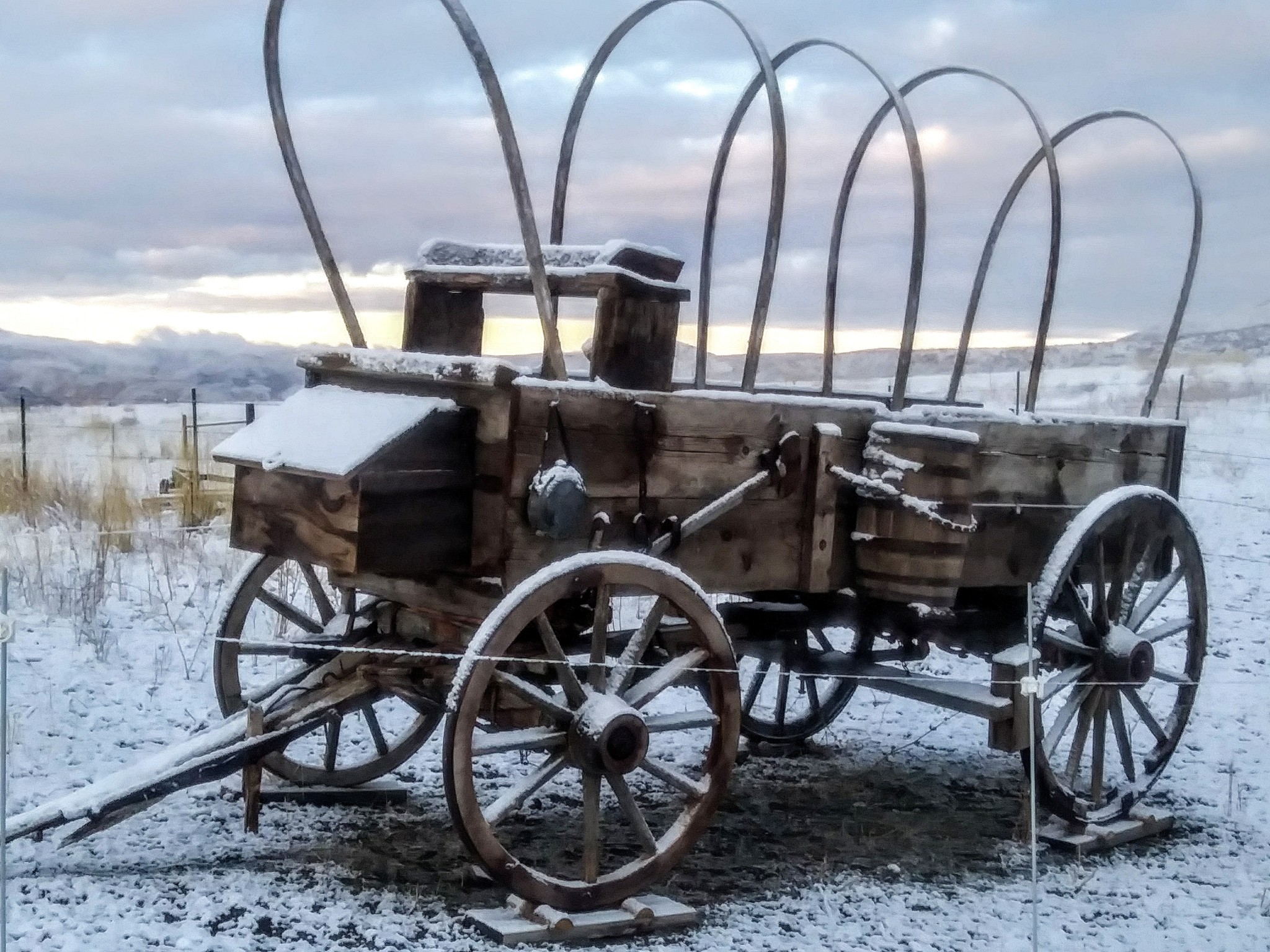
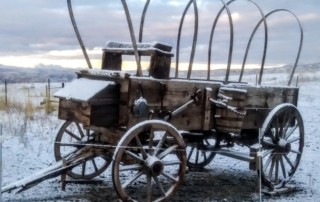
Sitting there in the early morning darkness the fire’s reflection illuminates a series of hand sculptured tiles inlayed across the hearth. They are tiles my parents had created by a local artist, Dean Estes, for Nancy and me. Dean is not only a gifted sculptor, but a long time family friend who took nearly a year to lovingly sculpture nine wax blocks with images taken from a series of black and white illustrations. They came from a book my dad had written which tells the story of our family’s westward journey by wagon train in the 1800’s. Dean transformed the wax sculptures into individualized clay tiles that he carefully glazed and fired.  Each tile represents a significant event which occurred on the long and difficult passage across the Great Plains and over the Rocky and Sierra Nevada Mountains.

Seeing these images every morning provides me with a reminder of my roots and heritage. They give me courage during seasons when my life becomes overwhelming. Thinking about what those early pioneers willingly chose to do somehow grounds me as a person living in the 21st century – a time when everything feels uncomfortably uncertain.  They challenge me to remember the pioneer spirit and strong values that motivated my early family to risk everything for the sake of a free and wholesome life. They urge me to embrace those values and that spirit for myself.

More and more people are looking for the life that Nancy and I have been seeking as we moved onto Timber Butte. The word sustainability has emerged in recent years to describe a desire to regain the pioneer spirit.  It speaks of breaking away from the confines and the feelings of vulnerability when living a day to day existence that is literally at the mercy of an uncertain social system.  Modern day homesteading (which can take place in the country or the city) is an effort to produce healthier food, drink better water, use renewable energy sources and experience the freedom to raise our families with righteous values for the sake of better and more meaningful lives.  The Apostle Paul once said as he concluded his letter to the Philippians, “Finally, brothers, whatever is true, whatever is noble, whatever is right, whatever is pure, whatever is lovely, whatever is admirable—if anything is excellent or praiseworthy—think about these things.” [Phil 4:8] Although he didn’t say it, I think Paul would agree that we shouldn’t just think about such things, but must have the courage to pursue them as well.

Looking back at my heritage gives me the courage and motivation to break away from status quo. It causes me to strive to recapture the values that must have driven those early pioneers to rethink and restart their lives outside the confines of a social system that no longer focused on what was true, noble, right, pure, lovely and admirable.  They longed for a new way of life and a new beginning, and they were willing to sacrifice to achieve it.  When we lose sight of our heritage it can cause us to flounder and lose our way.  I think of our nation for example; every time we begin to forget the principles and intent of our founding fathers we begin to redefine our values becoming weakened by division.  In doing so we forget who we are and why God once blessed everything we put our hands to. In the end we begin to gravitate towards being a society much like the one our founders rebelled against.  This can be true in our personal lives as well. Looking to the past can help us regain purpose for a preferred and better future. Even the bad things of the past can be used to launch us into a better and more fruitful future.

The old adage, “history repeats itself” generally holds a negative connotation. It is true, many times the child of an alcoholic can become an alcoholic, an abusive person has often been abused, but it doesn’t have to be that way.  Our negative past can help us strive towards a positive future.  It is all about looking back and learning not only from the valor of those who went before us, but from their mistakes as well. History will only repeat itself if we ignore and deny the past, refusing to make courageous choices to turn away from the bad so that we might cling to the good.  It is for this very reason that Nancy and I have dedicated our lives to Christ.  Making these kinds of life-changing choices is nothing short of miraculous – it’s something that only God can do. He came to forgive what needed forgiving from our past so we might live in freedom from habits, hurts and the painful memories that paralyze.  What he does is real and tangible, and for this reason faith was a key value for our pioneer ancestors. Regaining that pioneer spirit and the values that accompanied it – this is the hope for the challenges we now face in the 21st century.

Tags: , , , ,

Lesson #3 –Makes a smaller footprint for a bigger handprint – Entry #151

Saying goodbye to the Burmese Karen in 1981

Nancy and I chose unemployment and a downsized sustainable lifestyle for a reason.  I’ll admit, it was a joy living in the quiet seclusion of the old ranch for that season of time, but it wasn’t our intention to withdraw from society and live an inward reclusive lifestyle.  We had purposefully made the decision to downsize our life so that we could upsize our impact on the world around us.  Our experience in 1982 (see entries 149 & 150) taught and prepared us for a greater life of outward service. We had seen the broken world first hand and wanted to help make a difference with our lives.   We had also observed many with a heart to do significant things yet unable due to excessive debt load.  Many had lived beyond their means and were owned by material possessions.  We wanted to be in a position of freedom, not in the bondage of financial debt.  It was our goal to learn to make a smaller footprint with our lives by consuming less, owning less and not allowing the possessions we had to possess us. We wanted to express the viewpoint through our lifestyle that we had come into the world with nothing and would leave with nothing. We believed that it all belonged to God anyway.  We knew we were called to be stewards, not only of the land we lived on, but of all the things God cared about, especially suffering humanity.  We wanted to make a smaller footprint so we might be able to make a bigger handprint; the handprint being the imprint of God on the world around us.  It was with this thinking in mind that I eventually wrote the book, “Small Footprint / Big Handprint – How to live simply and love extravagantly”.

Nancy & the kids in a Karen village 1984

Now back to my story.  If you recall from my former blog, this whole adventure started when we felt called to Thailand to help a hill tribe people group called the Karen.  They had lived in Burma, but because of ethnic cleansing by the Burmese government, many had been forced to flee across the border into Thailand in an attempt to avoid mass murder and extreme persecution.  My exposure to the Karen was my first experience with such atrocities up close and personal. Getting the chance to know them and even live among them gave Nancy and me a kind of love that’s hard to describe.   The experience was so life-changing we knew at once that we could never live solely for ourselves again.  Our worldview had been shattered.  In the years to come we couldn’t watch the atrocities in places like Somalia or Darfur without being broken for the people involved. We desperately wanted to somehow help alleviate the suffering.  Even natural disasters such as hurricanes, tsunamis, floods or earthquakes and the pain they inflicted upon the extreme poor challenged us. We could no longer be spectators; we had to get involved.  No longer could I turn my back on things like human trafficking, world hunger, world health or

Teaching English in a Karen village - mid 80's

environmental degradation.  I knew these things where breaking the heart of God and should be breaking mine as well.  We realized that life had much more to offer than to simply withdraw and live for personal security, comfort, and survival.  We wanted to be part a greater cause.

If you want to successfully live a sustainable lifestyle you have to have a vision that is bigger than yourself.  Becoming a social dropout is tempting at times, but in the end it will lead to emptiness.   Nancy and I have tried to develop Timber Butte into a sustainable homestead not to pull back from society, but to add to it. We are striving to become more energy efficient for the sake of future generations.  We are attempting to learn better ways of organically producing food because we know how damaging mass production of factory farms can be to the environment and health.  We care about forestry practices because we have seen the effects of deforestation in the developing world where there is little or no restraints on clear cutting. We care about the preservation of water because we have seen the effects drought and pollution have had in so many parts of the world.  We want our lives to serve as an example for others to follow.

Nancy with African children years later in Zambia

 When I resigned from my job is 1982 I used the time to redesign myself.  I spent time evaluating what I thought was really important and how I wanted to spend the rest of my life.  We decided to put our financial concerns second to the pursuit of a life that had purpose and value.  I decided not to look for a job, but rather for a lifestyle that had meaning while still providing our basic financial needs.  I guess that’s how we ended up in the type of ministry we did. We didn’t want just any ministry, but a ministry that was intent on capturing the heart of God and fulfilling the commission of Jesus to love people and bring healing to broken humanity.  It was our aim to be part of a people who desired to be on the frontlines of suffering humanity, not merely to be content watching it on CNN.

 The third lesson I learned from being unemployed was that it gave me an opportune time to take a new direction and go after the things that would instill a new and lasting passion for life.

Tags: , , , , , , ,

Chili dinner resizeFor the last two years Nancy and I have been blessed by an annual visit from the Romeos. The Romeos (an acronym for Retired Old Men Eating Out) are a group of guys from the church who started to meet for breakfast once a week. All of them shared the common denominators of not only being retired, but also a passion to use their free time and skills to serve the Lord.  Because of their like hearts they developed a fellowship that both grew in meaningful

Reggie, John, Peter & Steve stack firewood

Reggie, John, Peter & Steve stack firewood

relationship and served a wonderful purpose.  They realized that within their group there was a vast diversity of skill sets learned from years of past life experience.  None of them were ready to sit in a rocking chair (at least not every day of the week) but found that with a little organization they could band together and do a lot of good.  That organization came through the original promoter of their group, Peter Grier.

The Romeo’s meet once a week for breakfast both for the joy of being together and to discuss various projects they might be able to do.  Often they are found helping single moms or widows who are in desperate need of a handy

Ken doing electrical wiring

Ken doing electrical wiring

man.  Other times they serve around the church.  I’ve recently learned that they will be serving tables at our woman’s Christmas Tea, a large event that blesses up to 300 women each year.

I don’t know why they volunteer to help me get ready for winter every fall, but I don’t ask any questions.  I only know I love to see them show up.  Every fall it seems like there are a dozen jobs Nancy and I are urgent to finish before the first snow falls at Timber Butte.  The last two years they have stacked our firewood, fixed fencing, prepared the barn for the

Morris runs the trencher

Morris runs the trencher

animals to take winter shelter and have even done some specialty jobs like doing electrical wiring.  This year they helped me get a sprinkler system in the ground and set it up on timers so that I’ll be able to plant grass in the early spring.

John prepares for pipe

Erv prepares for pipe

I know they like to bless me because I’m their pastor, but mostly I think they come for the big pot of chili Nancy prepares for them.   After all they are the Romeo’s – (Retired – Old – Men - Eating - Out)

Tags: , , , ,

nancy-in-garden-resize

Knowing how to grow a healthy bumper crop for harvest on a plot of land isn’t so much a matter of science as it is an art form.  Farming demands a passion to create as much as the know-how to grow things.  It requires a love and willingness for hard work, gratitude for God’s provision and a love for the gift and miracle of the earth’s  soil.  Maybe I’m wrong, but sometimes I think working the land somehow taps into and touches a hidden strand of ancient DNA that God placed in the human spirit for a purpose greater than growing fruits and vegetables.   I believe successful farming requires not simply the rooting of various plant species, but more so, getting in touch with the very roots of human existence, realizing that all of humanity began with a lone working couple who were called to tend a garden that God had established.  Genesis records, “Now the LORD God had planted a garden in the east, in Eden; and there he put the man he had formed.  And the LORD God made all kinds of trees grow out of the ground-trees that were pleasing to the eye and good for food. – The LORD God took the man and put him in the Garden of Eden to work it and take care of it.” (Gen. 2:8-15)  Mankind was created with a built in love and even a drive to participate in the thrill of harvest; it has been in us all from the very beginning of time.  My conclusion is that everyone has been called to farm and harvest in one form or another and because of it,  bearing fruit in our lives is the only thing that really satisfies the authentic need for human fulfillment. 

I’ve watched Nancy come alive this past summer as she has labored in our vegetable garden.  She and Lily, our small golden lab, spend hours together day after day planting, carefully cultivating between rows, watering and pulling undesired weeds with an anticipation of a fruitful future harvest.  Our garden is now becoming bountiful and beautiful and it is having the same effect on her.   It is medicine to her soul and a sedative of peace to her fears and emotions.  It is more than a plot of dirt but a place of healing, renewal and expectant vision.  A garden is not only a picture of the Kingdom of God, but is a tangible means of learning about it. 

The Bible tells us that the natural speaks of the supernatural, and because of it I believe the things we experience in a natural garden is characteristic of the things He desires for you and I.  He wants us to become rooted and established in His (the Fathers) love, he desires for us to mature and grow in strength under the warmth and in the light of His Son,  and to experience the refreshing and empowering of the Spirits rain. God made us for His spiritual garden, a garden that would one day be used in the process of producing a great harvest of human souls. 

[An excerpt from the rough draft of Tri’s new Book, “The Good Soil” which will be released in the spring of 2010]

Tags: , , , , , , , ,

6
Jul

The Harvest was Ripe – Entry #97

   Posted by: trobinson    in Agriculture

resize-022King Solomon once wrote; “For everything there is a season, a time for every activity under heaven.  A time to be born and a time to die. A time to plant and a time to harvest…”, and last week was our time to harvest hay up here at Timber Butte.  From the early hours of the morning until late into the night all of our neighbors have been out in their fields trying to get their hay mowed, raked, baled and undercover before it gets rained on and ruined.  Everyone has been working.  Like King Solomon said, timing is everything, and sometimes when the time is right you have to work until you feel like dropping. 

Because we all dry-land farm our hay crops up here we only can get one cutting a season and so when conditions are just right everyone starts their tractors and the harvest race begins.  Our race isn’t between each other, but against the elements of nature.   The moisture content of hay is crucial for the optimal nautical value of alfalfa and grass hay. In the case of alfalfa the plants must be at least 60% in bloom and the air must be dry. Normally our harvest starts sometime in mid June, but this year the rains continued to fall all month pushing things back a few weeks into July.  A lot of farmers in the valleys below who get more than one cutting attempted to bale their first crop too soon and the heavy June rains saturated their cut hay before they could get it under cover.  Moisture causes hay to mold and become not only unusable for healthy feed, but in danger of building up dangerous combustible heat, especially if it is stacked in barns.  Numbers of barns in southern Idaho have burned down this past month which is of course a great tragedy.

Last week everything seemed perfect and so Nancy and I took a week’s vacation and with the help of a few wonderful friends managed to put up 350 perfect bales (approximately nine tons) of grass / alfalfa hay in our barn and hay shed.  It was an exciting, exhausting, victorious week that I will write about in the coming days ahead.

Tags: , , , , , , , , ,

complete-resize1After stacking hay from last summer’s haying season it didn’t take long to realize how beneficial it would be to construct a shed to protect it.  Throughout the fall and winter months we covered the haystack with tarps trying to protect it from the pounding rain and snow storms that were nearly always accompanied by extreme high winds.  As hard as I tried it was a great struggle to keep the hay covered in winds that sometimes exceeded 40 to 60 miles an hour. It was especially difficult when I had to get into it at feeding time.  This country is so open and exposed to the elements that there’s little to slow down the microburst winds that periodically roar through.  Not only did we need tall pole structure, but it had to be built strong.  Hay sheds are tall, open walled structures built on stilt-like poles designed specifically for air flow to avoid mildew.

hay-stack-resizeVisiting with neighbors that had experience with such structures (some of which who had lived in the area for generations), I learned what to do and what not to do.  One neighbor told me he lost three different shed roofs to high winds before learning the secret of success.  Taking note of his counsel and my own past experience I set out to build my stilted structure as strong as possible with materials that were affordable for us.  Here are a few principles I think might be worth keeping in mind if you’re considering such a venture:

  • framinwork-resize1. First, I anchored my treated poles four feet deep – partially into the bedrock. I wrapped each pole in synthetic roofing paper and poured concrete into the holes they were set in. (I put 12″cardboard concrete forms around the base of each pole so that I could pour concrete two feet above ground level to provide extra protection.)
  • 2. Second, I used 6 ” ring-shank nails with washers to anchor the doubled 2×6 top plates to the upright poles and nailed extra hurricane clips on both sides of all the trusses.
  • 3. When I screwed the sheets of steel roofing down onto the 2×4 stringers I used extra long screws. I also increased the amount of screws roofing-resizeI used, especially on the outer edges that would be most vulnerable to wind gusts.
  • 4. I nailed several sheets of OSB to serve as shear panels horizontally on the inside of the main structure and added 45 degree bracing at every upright pole or post.
  • 5. Adding side lean-to type wings onto the main pole structure not only gave it extra stability (much like outriggers on a canoe), but extra covered space to store equipment.
  • 6. I left the ends of the shed open so that high prevailing winds could pass through without undue resistance.

wings-resizeSo far the new structure has held up to over 60 MPH winds and we pray will stay standing and serve us here at Timber Butte for years to come.

Tags: , , , , , , , , , , ,

Tri & Nancy 1970

Tri & Nancy with old dog Blue - 1970

There is a difference between having a dream about  a preferable lifestyle and having a vision for one. Dreams are often short lived fleeting pictures of a desired future or a preferable life circumstance.  A true vision is indelible and lasting and demands deliberate movement towards that future.  People who are dreamers often stay dreamers while visionaries are never satisfied with status quo.  Visionaries are planners, builders and aggressive learners.  Pursuing a life of sustainability requires more than a dream; it requires authentic vision and the tenacity to see it come to pass.  Vision inspires the sacrifice and discipline to pursue freedom from financial indebtedness.   It requires the willingness to do more things for yourself rather than relying on every kind of outside commodity.  A life of vision is a deliberate and focused life.  It is a life that spends time, energy and money on the things that really count; the things that will help you grasp the goal you set out to achieve.  I believe true vision is a gift of God.  Because he desires us to live purposeful and meaningful lives he  imparts vision into the hearts and minds of men.  It may take years to arrive at the envisioned destination, but if it is true vision and not a mere dream it will surely happen.  The book of Habakkuk chapter two says, “Write down the vision and make it plain on

Tri & Nancy @ Timber Butte 2009

Tri & Nancy @ Timber Butte 2009

tablets so that a herald may run with it. For the vision awaits an appointed time; it speaks of the end and will not prove false. Though it linger, wait for it; it will certainly come and will not delay.”  I have had visions about a lot of things in my life, especially when it has come to ministry, and can testify to the fact that a life of sustainability has to be more than a dream; it requires stick-to-it-ness.

In the 60’s everyone had a dream of living sustainable lives. The Hippie movement was in part birthed out of those dreams.  Hundreds of my generation moved into communes with great expectations of living with the land, consuming less and making smaller footprints.  Many of those that led in the Hippie movement of the 60’s became the American corporate leadership of the 70’s and 80’s.  For most, the Hippie movement was more of a dream than a vision.

Nancy & Brook at the cookstove - 1980

Nancy & Brook at the cookstove - 1980

Nancy and I never considered ourselves Hippies.  We love the rural lifestyle and the rich things it cultivated into our marriage. We had a common vision to raise our family in wholesomeness of the country lifestyle that we enjoyed in our early days of marriage.  (Read “About Tri & Nancy”.)   There were dozens of  inconveniences living the way we did; off the grid and an hour from town.  Fighting harsh weather, cutting cords of firewood to combat the coming cold winter, putting up hay – this was the strenuous hard work that never went away.  The remote isolation and absence of television and outside entertainment sometimes made us feel abnormal, but through it all we hung on to the vision we had received when we first had met which enabled us to press through the harder seasons we experienced.

In 1989 we moved to the city of Boise to establish the first Vineyard Christian Fellowship there.  Being church planters required us to live in the heart of a big city for the first time

Nancy & Brook at the cook stove 2009

Nancy & Brook still cooking on the woodstove 2009

as a married couple.  We really enjoyed the luxury of being able to walk to the market and to local restaurants.  Our kids entered regular public school for the first time and I could commute to work in less than ten minutes.  Now instead of bucking hay and cutting fire wood for exercise I started running and Nancy went to the gym.  Everything was easier and far more convenient, but when you have vision for a sustainable country lifestyle it just never seems to go away.  They say you can take people out of the country, but you can’t take the country out of people, and I  guess it’s true.

Early one morning after living in Boise for nearly ten years Nancy was reading her Bible and the Lord spoke to her out of Deuteronomy 1:6 where God spoke to the Israelites telling them that they  had stayed long enough where they were and it was time for them to break camp and advance into the hill country to the land He had prepared for them.   The Lord used that verse to re-establish the vision He had put into our hearts.  And so it is that we are again back in the country doing the things that gave us so much pleasure and satisfaction in those early days of our marriage.

Tags: , , , ,

18
Jan

Entry #32 – Solar hot water – Some things we have learned

   Posted by: trobinson    in Energy

Solar hot water panel facing south

Solar hot water panel facing south


picture-002


As I shared in my last entry, Nancy and I decided to incorporate a solar hot water system into the design of our new house.  We felt that it would be best to install it as the house was being constructed rather than try to plumb it in after the walls were insulated and closed in with drywall.  We also wanted it to be inspected and credited as a part of the LEED certification.  

I had met Dave Brueggemann president and owner of Solar Cascade www.solarcascade.com a year before we started building at Timber Butte.  Dave came to the church as an energy consultant during a time when we were investigating the feasibility of retrofitting our south facing roofline with electric solar panels. He was a world of information and the type of person you can’t help but really like.  As a result we asked Dave to design and install the solar hot water system for our new home.  Here again we discovered that incorporating some of these newer innovative technologies can be challenging as they have a tendency to put builders, subcontractors and inspectors on stretching learning curves.  In our case we discovered that the overlap between the conventional plumbers who were legally liable for the hot water tanks instillation didn’t like the solar guys retrofitting it with their invasive installations.  It was a hiccup that we didn’t anticipate, but with collaboration and a bit of flexibility on everyone’s part the conflict was eventually worked out.  In the end it was successfully inspected and signed off.

Read the rest of this entry »

Tags: , , , ,

Dunkan said he loves bucking hay

Duncan said he loves bucking hay

CLeaning up Dunkan

CLeaning up Duncan

  As Nancy and I moved ahead on our vision to develop a sustainable farmstead an amazing thing began to occur that we weren’t expecting. It seemed to us like the Lord was bringing a unique new group of people into our lives that shared a like heartedness for this type of lifestyle. One example of this occurred one day when I received an email at my church office from a guy named Duncan.  I had no idea who he was, but his short communication captured me.  It seemed like whoever was writing me had known me for a long time. He said that he knew of a place where I could find and cut cured firewood some thirty minutes from where I lived.  The letter revealed a number of things; he knew about where I lived, he knew that cured firewood would interest me, and he knew that I liked to get my own firewood.  In the busyness of life I soon forgot the email and dismissed it from my curiosity.  Six months later I received another note saying he knew where I could get some good square granite building rock and that he had a great trailer and winch if I needed help getting it.  His timing in writing me that note was amazing in the fact that I was planning to build a granite retaining wall around my barn and root cellar. (see entry #12)   He left his phone number so I decided to give him a call.  On the other end of the line came a voice that was full of life.  I knew immediately that this was a person I wanted to know.  Duncan was interesting and fun.   He and his wife Irene had been hay farmers for years until they decided to enter public education.  I had been a secondary school teacher for twelve years before entering the ministry and realized that we had a lot in common.   They had been attending the Vineyard, (the church where I pastor) for a couple of years, but because the church is large I had never had a chance to meet them.  In the course of our first phone conversation Duncan said that he missed bucking hay after leaving farming so many years before.  Nancy and I had about six tons of hay in the field right then that needed picking up and so I welcomed his enthusiasm and eagerness to lend a hand.  I remember the morning Duncan arrived for the first time.  I had no idea what to expect, but the minute I saw him I knew he would be a long time friend.  I love people who can make me laugh and Duncan had the gift.  That was a day of productivity and joy.

 If you’re at all familiar with the Bible you may know the story of the first church in the book of Acts.  One thing that was characteristic of those first Christian believers was that they really enjoyed each other.  In Acts 4 it says that they were “one in heart and mind” and they looked out for each others interests.  They shared things and helped each other with great joy.  It’s a picture or real community that happened because people shared the common denominator of a relationship with God. That was surly true of the relationship that quickly developed between us and Duncan and Irene.  Not only did we all share a common joy for country living, but we shared a value for the creator that made it possible.

Duncan still writes Nancy and I letters.  He gives us council on when and how to plant alfalfa, what to do about noxious weeds, and even exhorts us to not work ourselves to death taking a day off now and again.  Once he wrote, “I still haven’t figured out when you have a weekly day of rest! Definitely not on Saturday, Sunday or Monday.  You are wired with a different battery than I am.”

Duncan and Irene have become true friends that care about our vitality and understand our makeup.  They (like so many others) share with Nancy and I “one heart and one mind” in the things that really matter to us. 

Tags: , , , , ,