Posts Tagged ‘country living’

It has been nearly two months since I have made an entry on the Timber Butte Homestead blog site but it hasn’t been for lack of things to write about.   This has been such an eventful summer that I found it difficult to put aside the time to document it.   In June our son Brook was married to our new daughter in law Andrea and as I previously reported we hosted a sit down dinner in the barn for some sixty people after a major barn clean up and painting party. What a blessing that was.

 During the first weeks of July I took two weeks off from my normal work schedule to put up our year’s supply of hay. A job I could have never accomplished without the help of friends and family who not only helped keep the mower and bailer running, but bucked hay from the field to the barns. 

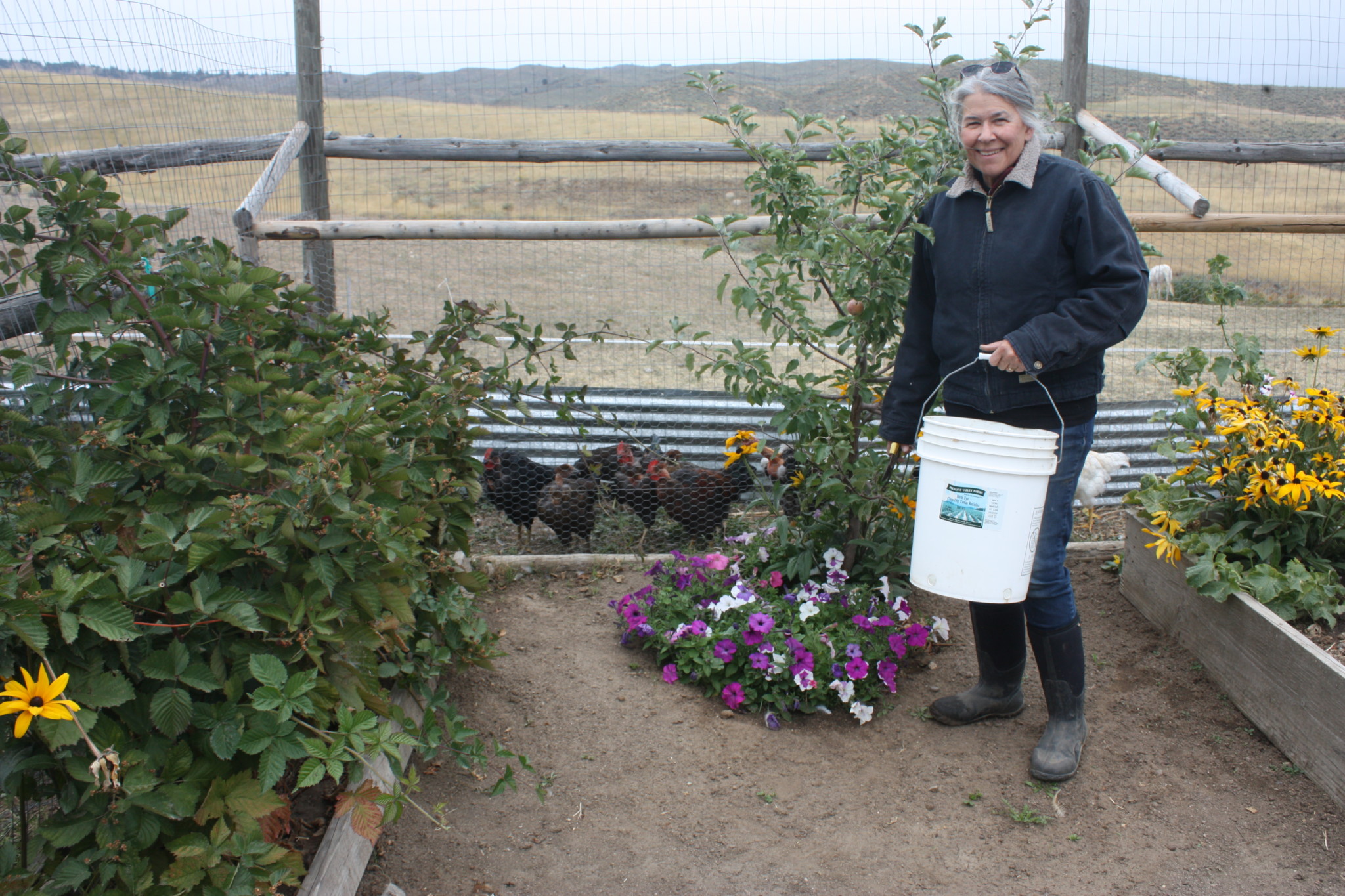
Nancy worked endless hours weeding, watering, harvesting and fighting to organically repel wave after wave of new grasshoppers. Even with the grasshopper battle our garden has been as beautiful as any we have ever grown. The root crops of potatoes and onions were especially amazing. With the help of my friend Rand Thompson I added a top rail to the ten foot deer proof garden fence which not only improved its looks, but made it a lot more functional. 

We finally got around to planting a lawn which not only made things look more established but gave us a better fire barrier around the house.  We also completed the first phase of our new vineyard as well, which required another learning curve. (More on what we have learned about grapes later.)

One of the great joys of the summer has been to host several pairs of swallows that discovered our homestead as a place to nest and raise their young. They decided that the barn, hay shed and house were a good place to construct their mud nests and in some of them they raised two different hatches. This has been a delight to watch but also a feeling of responsibility protecting their babies during their solo flights from Max and Pat the cats.

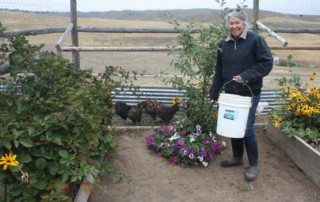
Nancy acquired sixteen new Bard Rock chickens from our friends, Tim and Tempe, and commissioned me to help her build another chicken house and run which out classed the duck run we had built in early June.  She is talking about eventually putting bird runs clear around the garden as part of her war strategy against the grasshoppers. 

One thing that occupied us the most all summer was our battle to save our horse Dusty. With the help of our friends Paul and Sheila Hudson we had trailered him to a vet in southern Idaho in hopes of a solution to a chronic foot injury we have been fighting for some ten years. We spent most of the summer doctoring him only to lose the battle for his life last week.  He was buried on a knob above the ranch which brought sorrow to everyone who had known him.  He was a wonderful and amazing animal who gave us great joy for some sixteen years.  Craig our neighbor has been fighting a similar battle with a chronic infection that has kept him bedridden for almost a year.   Many of the neighbors have jumped in to help him get in his hay and keep his ranch operating. He has been a wonderful friend and farming mentor to us and we continually pray for his healing.  

All in all it has been a productive summer, even a rich one, but surely not one of ease.  We have fought a grasshopper war, mourned the death of an animal that we all loved, been on an extreme learning curve on many fronts and worked most evenings until dark.  Nancy’s and my vision for all the Lord wants to do here has never faded however and because of it we have pressed through and have never lost our hearts of thankfulness and of the deep feeling of being blessed.

Tags: , , ,

15
Jun

A rooster gone bad – Entry #172

   Posted by: trobinson    in Agriculture, Country living reflections

A few weeks ago I passed the chicken coup while walking out to feed the horses.  It was a mild evening and the air was fresh and calm until a ruckus suddenly broke the serenity of the moment.  On the back side of the chicken coup I heard Nancy yelling in anger saying things like, “If you want a piece of me big boy come and get it!!!”   Frankly it was alarming until I realized she was yelling at Theodore the rooster who had attacked her for the third time that week.  He used to be such a sweet rooster, but in recent months had started listening and responding to the voice of his bad angel who must have been telling him to get in touch with his testosterone.

As you may remember, Theodore was an orphaned rooster that had found me one day while I was collecting rocks out in the middle of nowhere.  He was mysteriously sitting under a bush half starved when I first spotted him and he immediately came to me for rescue when I stretched my hand in his direction.  He literally jumped into my arms. (See Entry #91 – June 9th, 2009 – “Our new mystery friend”)  I brought him home and Nancy, being who she is made a special place for him to recuperate.  She had lovingly cared for him and protected him from the other chickens until he was finally strong enough to hold his own.  For months he was docile and friendly letting anyone pick him up and lovingly hold him in their arms.  It took awhile for us to even figure out what kind of a bird he was much less his sex.  He was always different than the other chickens and for a long time unaccepted, especially by the older rooster.

Theodore during his adolescence

Early one morning I approached the coup before daylight with the feed bucket, and as I cracked opened the door I heard an adolescent sounding crow.  As I turned on the light I spotted Theodore sitting on a high perch looking somehow different.   I think the noise that came out of him was as surprising to him as it was to me. From that day on he started to change.  He had gotten in touch with his masculinity and within weeks was choosing off the older dominate rooster.  Actually it was kind of sad. Not only had we lost our sweet little pet, but our older rooster who had taken his job running the roost with dignity was overpowered by Theodore’s new aggressive urges.   Theodore was now the king of the harem and it soon went to his head.  Unlike the older rooster (who eventually died of a broken spirit) Theodore could fly.  He could fly not only to the top of the coup fence (his new found place of superiority), but over the fence where he was not afraid to challenge dogs, cats, innocent children and to his demise, Nancy and I.

Even Lily fears Theodore

Even Lily our Labrador became intimidated by him and our granddaughter Hope started to arm herself with sticks and garden tools when walking across the barnyard.   One day Theodore even chased a thirty year old friend of our son Brook into the back of his pickup truck. He was trembling in fear while avoiding the macho young rooster’s aggressiveness (at least that’s how Brook and his other buddies related the story to me.)   That’s when Nancy had enough.  Theodore was either going into the stew pot or going to receive some serious therapy.

Theodore learns not to mess with Nancy

Nancy soon learned that fighting fire with fire only made the problem worse. For example, kicking and hitting him over the head with a feed bucket in response to his spurring charges only seemed to make him meaner, feeling justified for his sneaky stealth attacks.  Theodore always attacked when you least expected it.  Not knowing where else to go for help Nancy finally resorted to the internet.  As amazing as it seemed to me she actually discovered an article on taming mean roosters.  It had been written by an old farmer who evidently had had the same dilemma.  Anyway, for the past two weeks she has been catching Theodore any time he even gets that sly devious look in his eyes.  She holds him tight in her arms and taking her index finger presses down his beak into his chest holding him in submission for up to ten minutes at a time.  I don’t know if it will work, but it’s her best effort to save him from sure death and her from the trauma of losing her cool and ringing his poor little rooster neck in a fit of unladylike rage.

The following is a great article on taming mean roosters: http://answers.yahoo.com/question/index?qid=20070503071406AAJC8T1

Tags: , , , , , ,

7
Jun

A celebration of blessing- Entry #171

   Posted by: trobinson    in Country living reflections

When I built the horse barn I hadn’t dreamt it would one day become the place that we would host a rehearsal dinner party to celebrate the wedding of our son Brook and new daughter Andrea.  Last Friday evening however, over fifty people sat down to eat a wonderful meal together while a live Bluegrass band played in the hayloft above. 

A few months before when Brook asked about the possibility of using the barn for such an occasion we naturally jumped at the idea.  We hadn’t guessed at the time that June would be one of the wettest in recent history.  Literally an hour before the party started on Friday evening a lightning storm blew through bringing with it not only the crashing of thunder but a torrential downpour of driving rain.  I also hadn’t considered the idea that the invitation list might grow at the last minute to be more folks than our four horse barn

The High Desert Bluegrass Band

could possibly accommodate.  The fact of the matter was, we were all so excited for the occasion our enthusiasm would override any obstruction.  We were blessed to be asked and started to plan the event right away.  Nancy figured out the food and I started to clean out the barn. With some great help I shoveled out a mountain of manure which had been accumulating all winter and even painted all of the interior walls. (See entry’s #167 & 162)  The day of the dinner we had fun doing the finish work with some wonderful old friends who have known and loved our kids for years.   We covered the floor with wood shavings, set up tables and decorated them.  In the end nearly sixty people comfortably sat down to the BBQ dinner.  

Rand Thompson and the High Desert Bluegrass Band set up in the hayloft and played through-out the entire evening.  Not only did the night turn out to be a joyous celebration, but the rain and wind moved on leaving behind only the cool fresh smell of spring in the air.  When the evening ended we all recognized that God had blessed the night and the marriage covenant which was about to be made between Brook and his beautiful bride Andrea.

Tags: , , , , ,

I think everyone who loves to garden ends up accumulating a plethora of various kinds of digging tools.  Spade shovels, flat nose shovels, scoop shovels, rakes, pitch forks, etc. are all a necessity for those of us who spend the warmer months digging in the dirt. What’s really frustrating however is when you need a specific tool but can’t seem to locate the proper one when you need it the most; not only that, but having tools lying around everywhere makes your place look untidy and disorganized.   That was our case and the frustration of it finally motivated me to figure out an inexpensive solution.  Most of our tools generally seemed to end up leaning against the garden fence line and I realized if I was to build some sort of a rack to hang them on the best place to locate it would be where they would naturally end up.  Because my new tool rack would be outside where things would be close at hand I decided to construct something that could stand up to the weather during the spring and summer seasons.  Here is my solution.

"A" - 1/2 inch foundation bolt

Looking around through my junk I spotted some left over ½ inch foundation bolts.  They were ten inches long and had a perfect “L” shaped hook at the end.  (See picture A) I realized that their threads where just long enough to be bolted to a left over 2X12 I had scrounged from my scrap pile.  I drilled sets of ½ inch holes four inches apart down the 2X12 leaving 10 inches between each set of two.  I bought an extra set of washers and nuts for each bolt so that I could put a nut and washer on each side of the plank.  (See picture

"B"- Bolts anchored in 2X12 plank

B)  After cinching them up tight I bolted the ten foot rack on the garden fence and gathered every tool I could find and hung them between the foundation bolts.  Already this small simple invention has made our lives easier.  Not only is it easier to find the tools we need but it did in fact make the garden look uncluttered and tidy.

Tags: , , , , , ,

18
May

“Many hands make light work” – Entry #167

   Posted by: trobinson    in Building Projects

I had been dreading the thought of painting the interior walls of the barn for months. The thought of cleaning it out masking windows and doors, and spraying some 3000 square feet of walls (walls that are 18 feet tall) overwhelmed me.  By myself I knew the job would take me several days and dozens of trips up and down tall extension ladders.  I wanted to do it, but thinking about the effort it would take kicked in that old enemy of progress, procrastination. 

Last Christmas our son Brook announced his engagement to a girl we all love, Andrea Dotters.  He proposed and gave her a ring on Christmas Eve and the excitement and preparation of a June wedding went into motion, especially at the Dotters house.  Other than having the privilege of facilitating the service as the marrying pastor, my only real job was to prepare the barn for a rehearsal dinner here at Timber Butte.  The thought of the party was exciting and motivating, especially considering the blessing of the occasion and so even though the size of the task was challenging, the vision of what it was for spurred me on. 

Several weeks before we had shoveled out a mountain of horse manure after a winter of accumulation (See entry #162) in preparation for the paint job we had scheduled for this past Saturday.  After a winter of thinking about it, the day had finally arrived.  I got together the paint and

Nathan & Nathan climbing ladders

supplies needed and headed for the barn early last Saturday morning where I started to clean the walls of hanging tack and the floor and loft of tools, bales of left over hay, welding equipment and miscellaneous paraphernalia which had accumulate in the many nooks and crannies. After a couple of hours of prep work I was ready to start masking and fire up the airless spray rig to start painting. That’s when I heard the welcome sound of Nathan’s diesel pickup coming up the road. 

As the pickup came to a stop two young guys jumped out eager to lend me a hand.   Not only did Nathan Harknes who had helped me do projects on two other occasions, but he brought Nathan Evans who had come over from an island in Hawaii to attend our VCOM school of Biblical Action.  They were a welcome sight and without delay we all got to work.  Later in the day Josh and Melissa Fishburne showed up after having run a thirteen mile half marathon that same morning and jumped in as well.  Nancy cooked a great meal for everyone keeping the moral high and by five o’clock that afternoon not only were the walls and stalls painted  but the spray rig was cleaned up and all the tack and other paraphernalia was hanging back on the walls again.   The barn looked more beautiful than I had expected and ready for the celebration we were all anticipating with excitement. It goes to show that the Amish people are right when they say, “Many hands make light work”.

Tags: , , , ,

Nancy had another idea. She thought it would be handy to have a sink in the garden to prewash vegetables before bringing them into her kitchen. She also thought an outside sink might provide a good place to prewash me before letting me come in the house – considering my reputation for getting filthy after a day of ranch work. (Have you ever seen the Peanuts cartoon character named Pigpen?)

Anyway, for whatever reason, we picked up a used cast iron sink complete with faucets and drains for only forty bucks at a second hand store in Boise.

Sink framework & concrete mesh

After loading it in the back of my pickup and nearly getting a hernia in the process I realized I would need to build a really stout stand to set it on. Stopping by Home Depot on the way home we purchased treated 4X4s and 2X4s needed to hold the weight and then proceeded to look around for materials to build a counter top able to withstand every type of weather possible.  We knew that the sink would be sitting year after year under deep snow and in freezing temperatures during winter months, in driving rain storms in the springtime, and under brutal hot sun in the summer.  I’ve built outside sinks before and my experience told me that if we wanted it to serve us for a long time and look half way decent in the process it would have to be durable.  We thought about using a sheet of galvanized steel for the counter, but knew how hot it would get in the summer heat. I also believed that tile would eventually get water under it and cause it to crack in the winter freeze. After consulting with a nice lady in the paint department we finally went home with a quart of epoxy all weather paint which we planned on applying over a 3X5 sheet of hardy concrete board, but I knew even as I decided to take her advice that it would be temporary at best.

Rand helps me set in the sink

On the way home I had an epiphany. (I do some of my best brainstorming while driving.) I remembered how years before I had used concrete to provide a water and fireproof roof system on a generator house I had built.  I recalled how it not only had lasted but looked great as well.

That evening I constructed the framework using the treated lumber we had bought, keeping in mind that it would have to support not only the heavy cast iron sink but an inch of concrete as well.  The next day, which happened to be my day off, Rand Thompson came by and helped me pour the counter top and set the sink in place.  As we mixed the

Troweling the finshed cement

cement (I mixed it 4 to 1) I remembered a small unlabeled bag of concrete die I had left over from some previous project. Not even knowing for sure what color it was, I added it to the mix. It turned out to be black which ended up looking really nice. Because it was windy and rainy we poured the cement top under cover in the barn.

After allowing it set up for several days I decided it was time to move it to the garden.  I can’t tell you for sure how heavy it was when all was said and done, but I couldn’t budge it more than an inch or so by myself so decided to fashion a sling out of nylon rope and moved it to the garden with the bucket of the tractor.   I’ll admit that I feared cracking it in the process, but everything went well. I ran the drain lines into a one inch PVC pipe that transported the reclaimed water into the garden. It is now permanently plumbed and ready for dirty vegetables or a dirty husband.

Tags: , , , , ,

20
Apr

Spring cleaning – Entry #162

   Posted by: trobinson    in Country living reflections

Winter at TImber Butte Homestead

Winter is not only a confining time but a difficult time to keep things tidy. Winter has a beauty of its own; there is no doubt about it. But, living in snow country has the tendency of being confining and conducive to the buildup of clutter both in the house and barn.  With warmth and lengthening of spring days the time of dormancy lifts and not only brings renewed life to the land, but in a special way to our human spirits as well.  As doors and windows fling open allowing the freshness of the new season to enter in we become simultaneously ready to get out in the fresh air. 

Nancy spring cleans her gardening room

 Spring has a special way of motivating and energizing us to reorganize and clean things up.  Every year it offers us a new beginning; it’s a time to prepare the garden for another growing season, turning over the rows and setting up irrigation line for easy maintenance. It is a time to prepare the green house for fragile plants not yet ready for early planting due to erratic climate changes. It is a time to muck out the barn and mound up a winter’s accumulation of manure in preparation for next year’s compost. It’s also a time to fix broken pipes that had become casualties of the subzero winter temperatures because they had been inadequately drained in the previous fall.  Spring is a time to reorganize and prepare for the animals on the homestead; time to feed the bees and let the chickens out of their coup so they can free range once again.

 Spring cleaning is liberating to the soul.  There is something wonderful about ridding oneself of the chronic buildup of unneeded clutter.  After years of living out this spring cleaning scenario I’ve realized that it must be a common characteristic of our human natures to accumulate unneeded stuff. Unused

Our friend Nathan lends a hand mucking out the barn

possessions have a mysterious way of filling our closet shelves, cluttering drawers, being stuffed under beds and in the once spacious places of garages and barns. I’m speaking of the things that we once believed we needed, but soon cease to have any real functional value. Cleaning out the clutter not only takes deliberate effort but the honesty to admit we really don’t need a lot of extra stuff.  Simplicity is a gift once it is achieved, but it is a gift that requires a deliberate choice and effort to go after it.

 A number of years ago I wrote a book entitled, Small Footprint, Big Handprint – How to live simply and love extravagantly.  It was based on a series I taught which I called, The Biblical Pursuit of a More Simplified Life.  The book and teaching were a challenge for folks to downsize their lives for the sake of upsizing their impact on the world around them. It spoke of a mega spring cleaning of their personal lives, not just for the sake of simplicity, but for the sake of effectiveness in the lives of others.  It illuminated the fact that far too often our

This years manure is next years compost

possessions own us more than we own them.  It showed how things in our lives can encumber us with physical, emotional and even spiritual debt.  God’s intent is that we would not be in bondage from the things of this world but be free and in fact, “free indeed” [John 8:36]. It is in freedom that we then have the liberty to become the people God originally intended us to be.

Fixing pipes that didn't survive the winters freeze

 I don’t want to over spiritualize this “spring cleaning” thing, but I do believe that the reason it feels so wonderful when we choose to do it is because it is a physical picture of a more important spiritual reality.  In our heart of hearts we want to be free from the things that encumber us.  Life has a way of stuffing away the destructive clutter of memories that are unedifying and even painful. These memories start to override God’s goodness and His greater purpose for our lives. They encumber our minds and hearts causing us to lose the freedom we were created to have.  That’s why Jesus said in John 8:36, “So if the Son sets you free, you will be free indeed.”  It is God’s heart and intention that we experience real freedom.  His provision of Jesus provides the greatest spring cleaning of all – the cleansing of our souls.

Tags: , , ,

After our visit to Inland Desert Nursery I came home motivated to start off our small vineyard right from the beginning.  Having a close look at what Tom had done I realized how important it was to build a strong support trellis system before the vines had a chance to develop. Observing his trellis system gave me a lot of good ideas.  I also realized how expensive trellis construction can be so when I came home I decided to improvise using as many things as I could that were lying around the place. Our vineyard was obviously extremely small, but still part of the goal of sustainability is to use as few outside resources as possible. As a result I tried to take advantage of my junk pile.  For my main supports I used cedar posts that had been left over from the corral. I used surplus wire from my fencing supplies and unused drip line from the vegetable garden.  My posts were only seven feet long which meant having just five feet out of the ground, but after a little research I discovered that in our colder climate a shorter trellis would be sufficient due to the shorter growing season. I used 10 gauge non-galvanized wires for my main supports after hearing not only how heavy the vines would become when fully mature, but also that galvanized wire can become toxic to the fruit. (I’m not certain that every vintner would agree with this however).

Fencing ratchets can be tightened at any time to maintain tight wires

The first thing I did was dig three foot holes several feet beyond the arbor rows in order to construct anchors.  These anchors, also known as “dead men”, are used to stretch and hold the support wires taut.  I set a steel rod in each hole and filled them with concrete. I used leftover steel electric fence wire posts (again procured from my junk pile) Using an acetylene torch, I twisted the ends into rings so that I could later attach and stretch my wire from them.  I then set my cedar posts every sixteen feet down each row.  Two grapevines would later be planted between each post. Note that I also set my two outside posts at slight outward angles for extra support (see pictures).  I then drilled holes through the posts so that the support wires might be strung through them at appropriate heights.  Of the vineyards I observed I had not seen this done, but it seemed like a good idea to me.  Most modern vineyards use heavy steel posts that are specially manufactured for this purpose, but again I used what we had laying around.

Holes drilled trough the posts holds the wires and irrigation line

Finally, I stretched the wires from one end of the row to the other using fencing ratchets (which cost approximately $3 found apiece at places which sell fencing products.)  I decided to use these for two reasons: first, because they are excellent for stretching heavy gauge wire; and second, because they can be used at any time to tighten wires the lose tension as the vines increase in weight.

 After all my wires where in place I added my drip line, suspending it from the bottom wire.  The drip line is generally a foot above the ground so that it is out of the way of weed hoeing and mulching.  Note also that I strung my three wires at one foot (drip line wire) 30” and 48” (vine support wires). 

 Tom told me that if our first season goes well our vines should reach the first wire.  He told us to keep only the two most healthy shoots that come off the root to be trained on the 30” wire. These would become the two main vines to be trained on the 30” wire. He recommended that they be twisted when they reach the wire so that one goes each direction.  These two vines will grow down the wire four feet in each direction. For this reason each vine is planted eight feet apart.  The next year these two main vines will produce shoots that will be attached to the 48” vine and produce rich fruit there in the years to come.

Tags: , , , , , , ,

12
Apr

Planting a vineyard – Entry #160

   Posted by: trobinson    in Agriculture

It always seems to me that the more you learn about something the more you realize you don’t know. Preparing to plant our first vineyard at Timber Butte has been another one of those humbling experiences.  Over a year ago I decided to prepare a series of terraces adjacent to our root cellar for a future vineyard (see entry #106). I realized at the time that we knew nothing of grapes and vineyards except for the fact that they needed plenty of sun to thrive.  Just as the many things we have been learning to do at Timber Butte Homestead, I decided to cross the “vintner” bridge when I came to it – which I figured would be the following spring.  As always, time flies and the following spring has now sprung upon us so Nancy and I took a two day road trip to central Washington to visit “Inland Desert Nursery.”  We went there to buy grapevines and get a few basic pointers from a real vintner named Tom Judkins. Our experience was far beyond our expectations.

The five hour drive to Inland Desert Nursery was worth the effort

 Nancy had called ahead and shared our need with Tom’s son Jerry who was more than helpful, especially considering the size of our order. Taking into account our elevation and climatic zone as well as our desire to grow both table and wine grapes Jerry suggested the hardiest varieties for our area. After their short conversation we concluded it would be worth our while to make the five hour drive to pick up our small order so we could get a little more firsthand instruction on planting and care.  Inland Desert Nursery generally only deals with larger commercial operations but was willing to sell us just thirty bare root vines.

Following our GPS we were led several miles out of Benton, Washington through acres of vineyards and fruit orchards until we were told by the mechanical British voice on the GPS (we fondly refer to as Roger) that we had reached our destination on a dirt road in the middle of a vineyard.  There wasn’t a building in sight.  After a quick phone call Tom Judkins’ daughter Kim guided us to a series of structures where dozens of workers were industriously preparing what looked to be hundreds of large commercial orders for the spring planting.  In the scheme of things we felt really insignificant knowing how small our order had been. 

Our friend Sally from England volunteered to help plant the terraces with our new vines

 The morning air was cold and breezy as we stepped out of our car and I think we must have looked a little disorientated as we tried to figure out where to go and who to talk to. It was then that a kind Hispanic lady approached us and asked us if we were there to pick up an order. Realizing our confusion she led us into a nearby green house where we met Tom for the first time.  He immediately recognized us as rookies but treated us as if we were buyers preparing to plant a hundred acre vineyard.  We weren’t expecting anything like the help and attention we received for the next hour.  He took us all through his operation showing us the different growing techniques and new types of grapevines his family was experimenting with.  He had a passion for his work and his easy manner gave us an appreciation and excitement to learn as much as we could in our short time with him. He loaded us in a pickup with his chocolate lab, Harvey, and drove us out into a young vineyard to teach us about constructing trellises and irrigation systems.  He patiently answered our plethora of questions concerning soil condition, vine planting, pruning and watering.  Had I realized we’d be having such a great educational experience I would have brought a notebook to take notes or figured out some other means of retaining all that we were learning. As it was, I made a simple diagram that evening in hopes of reminding myself of some of the simple things I observed.

I drew a quick sketch in hope of retaining some of what I had learned

I can’t imagine Tom would have the time to spend with every customer that he did with us that morning, but for Nancy and me the time he gave us was a rich blessing.   We headed back to our home in Idaho with our heads full of new information and our hearts enriched because of the time we experienced with someone who loved working the land as much as we do.

Arriving back at Timber Butte that evening we were welcomed by Lily, our golden lab, and Sally, a young friend from England who had been watching the homestead in our absence.  After hearing of our adventure Sally volunteered to stay over and help us plant these first vines the next morning.

In the days to come I will chronicle here on the Timber Butte Homestead site our step by step progress growing this first small vineyard for anyone who may be considering doing the same.  I will share as well as I can the experiences we are having and the few things we have learned which are basic and crucial to the success of a productive vineyard.

Tags: , , , , , , ,

We planted potatoes and onions on Monday and they were covered with snow by Thursday, which just happened to be April Fool’s Day.  I’ll admit that I’ve got a bad case of spring fever and the joke was on me. Last week Nancy and I took a walk along the south facing slope of Timber Butte and saw some early flowers peek their heads up in warm protected areas. It put hope in our hearts, but then the weather changed and it was like the proverb states, “Hope deferred makes the heart sick…” (Proverb 13:12a) I, for one, am more than ready for a new season. Next Sunday we will celebrate Easter which is all about resurrection and new beginnings.  This is more like the second half of the same proverb, “…but a longing fulfilled is a tree of life.” (Proverb 13:12b)

During this hard season of recession many folks are struggling in a lot of ways.  There is a scary uncertainty in the air not only economically, but on many fronts.  As a pastor I am constantly aware of people’s fears and personal crisis issues. The stresses of life have a way of causing relational struggles in marriages, with friends, employers and extended family.  Even physical health can be affected.  Most everyone I know is ready for a brighter new season in their lives and like the last few weeks up here at Timber Butte we get glimpses of warmer sunnier days to come. But, then on the heels of the temporary hint of spring weather comes another snow or windy hail storm. 

In all of this, the good news always is the same – God is a God of redemption and renewal.  He is a God of new beginnings and fresh new starts.  Romans 1:20 tells us that God reveals his nature through all that he has created and he created changing seasons. Winter will eventually turn spring even if our hope gets deferred a time or two in the process. God’s intent and promise to those who love him is for the gardens of their lives to spring up and grow in the full sunlight and warmth of his presence. In a way you might say this is the message of Easter.  Jesus came to humanity to bring the provision of redemption to anyone who would accept and receive it. For those who choose to praise him he pours out his grace, healing and the promise for new life. Isaiah put it like this, “The Sovereign Lord will show his justice to the nations of the world. Everyone will praise him! His righteousness will be like a garden in early spring, with plants springing up everywhere.”(Isa. 61:11)

Tags: , , , ,

27
Mar

Homemade garden gates – Entry #158

   Posted by: trobinson    in Building Projects

A while ago I visited the Shaker Plantation in Pleasant Hill, Kentucky.  I love not only studying the construction of early American structures, but also such things as handmade tools, furniture, fencing and gates.  I get great pleasure in reproducing things here at Timber Butte so that they are in keeping with and give the feel of homesteads from years past.  We try to use as much of the natural rock and logs as it is functionally possible for this reason.  Whenever we visit places like the Shaker village I look extra close at things and take pictures so that I might incorporate ideas here at home.  I guess it is more of a hobby than anything. Like many others, I get deep satisfaction using my hands in my free time.  Generally I have far more projects than I have time for, but the vision to do them keeps me going.   

Building gates is not only functional, but can save tons of money, also there is something about handmade stuff that makes things look quaint even if they are only subconsciously noticed.  Recently Nancy and I have planted a new

Cutting plug & hole

lawn around the house which when established will be susceptible to the abuse of loose horses or cows.  It’s amazing what a horses hoof can do to a fragile lawn, especially when they know they are being naughty and decide to spin around and flee when trying to be caught.  It can be a mess.  For that reason we decided to fence and gate it off.  Because it is in our front yard we wanted it to stay in keeping with our homestead vision.  Here’s what I did:

First I cut lodge poles to appropriate lengths drilling them in the same way I did when I construct the lodge pole gate for the corral and entrance (See Builidng Projects - entry #94.) In this way I made both holes and plugged pole ends. (See picture) I then

Assembling the frame

screwed together my main gate supports.  Second I cut short lengths of lodge poles down the middle with a table saw.  This takes a little practice to make even splits, but perfection isn’t all that important.  Remember the object is to make things to look homemade not like they have been stamped out in some factory.  I always refer to my mistakes as a means of providing unique and quaint touches.  Then I screw these half pieces onto  the frame making sure things are as square as possible.  Making gates square will make them hang even when they are hinged to the upright posts. 

I’ve made dozens of gates like this in my life and have discovered that if they are done with care they will serve

Attaching half cut logs

you well for years. In the past Nancy has planted climbing roses or vines that grow up and over them covering up all of my mistakes making them look all the better.

Tags: , , , ,

Winter has seemed long this year.  It could be my age, or maybe I feel like this every March but forget the feeling of dreariness from the previous year. February was a cold month that brought low, cold clouds rolling up the foothills slowly engulfing us to the point of causing our worldview to become small and bleak.  More than once Nancy and I would spontaneously sing the line from the Broadway play, Annie, “The sun’ll come out tomorrow; bet your bottom dollar that tomorrow there’ll be sun!”  Singing it felt encouraging and somehow optimistically prophetic when everything around was so gray.  

Then one day it happened as it always does at this time of year – the clouds lifted taking with them the drabness we felt.  The sun broke through, melting away the remaining snow and allowing the ground to absorb heat and finally thaw.  The air was still crisp but the hope of a new season was renewed and so was our vision for the creation of yet another productive vegetable garden.   

Our friends, Elliot and Marilyn, feeling invigorated by a stretch of warmer weather themselves, offered to lend us a hand for a day.  We graciously accepted and along with our granddaughter, Hope, we spent the better part of a Saturday prepping raised beds in the garden. Elliot and I turned over the soil, reforming the mounded rows while Marilyn and Nancy raked in gypsum and planted Winter Rye grass.  Gypsum helps to loosen the compacted soil while breaking up clay. Winter Rye on the other hand is a green crop that adds nitrogen when spaded into the rows later in the season in preparation for vegetable seeds. 

Hope worked alongside us driving in stakes and stringing lines so Elliot and I could construct the new rows straight and even. As we all labored outside for the day, we used muscles that had been dormant all winter. Although those muscles would let us know about it the next day, our spirits were renewed and revitalized as we enjoyed the fresh air and the beginning preparations for a promised harvest to come. 

If there is a moral or point to this short story it might simply be this: The sun will always come out tomorrow and when it does, it’s not a time to sit but to rise up and act on the renewed hope it will surely bring.  Life is full of seasons, and every season has its purpose.  As King Solomon once said, “There is a time for everything, and a season for every activity under heaven…” [Eccl. 3:1]

Tags: , , , ,

Lesson #3 –Makes a smaller footprint for a bigger handprint – Entry #151

Saying goodbye to the Burmese Karen in 1981

Nancy and I chose unemployment and a downsized sustainable lifestyle for a reason.  I’ll admit, it was a joy living in the quiet seclusion of the old ranch for that season of time, but it wasn’t our intention to withdraw from society and live an inward reclusive lifestyle.  We had purposefully made the decision to downsize our life so that we could upsize our impact on the world around us.  Our experience in 1982 (see entries 149 & 150) taught and prepared us for a greater life of outward service. We had seen the broken world first hand and wanted to help make a difference with our lives.   We had also observed many with a heart to do significant things yet unable due to excessive debt load.  Many had lived beyond their means and were owned by material possessions.  We wanted to be in a position of freedom, not in the bondage of financial debt.  It was our goal to learn to make a smaller footprint with our lives by consuming less, owning less and not allowing the possessions we had to possess us. We wanted to express the viewpoint through our lifestyle that we had come into the world with nothing and would leave with nothing. We believed that it all belonged to God anyway.  We knew we were called to be stewards, not only of the land we lived on, but of all the things God cared about, especially suffering humanity.  We wanted to make a smaller footprint so we might be able to make a bigger handprint; the handprint being the imprint of God on the world around us.  It was with this thinking in mind that I eventually wrote the book, “Small Footprint / Big Handprint – How to live simply and love extravagantly”.

Nancy & the kids in a Karen village 1984

Now back to my story.  If you recall from my former blog, this whole adventure started when we felt called to Thailand to help a hill tribe people group called the Karen.  They had lived in Burma, but because of ethnic cleansing by the Burmese government, many had been forced to flee across the border into Thailand in an attempt to avoid mass murder and extreme persecution.  My exposure to the Karen was my first experience with such atrocities up close and personal. Getting the chance to know them and even live among them gave Nancy and me a kind of love that’s hard to describe.   The experience was so life-changing we knew at once that we could never live solely for ourselves again.  Our worldview had been shattered.  In the years to come we couldn’t watch the atrocities in places like Somalia or Darfur without being broken for the people involved. We desperately wanted to somehow help alleviate the suffering.  Even natural disasters such as hurricanes, tsunamis, floods or earthquakes and the pain they inflicted upon the extreme poor challenged us. We could no longer be spectators; we had to get involved.  No longer could I turn my back on things like human trafficking, world hunger, world health or

Teaching English in a Karen village - mid 80's

environmental degradation.  I knew these things where breaking the heart of God and should be breaking mine as well.  We realized that life had much more to offer than to simply withdraw and live for personal security, comfort, and survival.  We wanted to be part a greater cause.

If you want to successfully live a sustainable lifestyle you have to have a vision that is bigger than yourself.  Becoming a social dropout is tempting at times, but in the end it will lead to emptiness.   Nancy and I have tried to develop Timber Butte into a sustainable homestead not to pull back from society, but to add to it. We are striving to become more energy efficient for the sake of future generations.  We are attempting to learn better ways of organically producing food because we know how damaging mass production of factory farms can be to the environment and health.  We care about forestry practices because we have seen the effects of deforestation in the developing world where there is little or no restraints on clear cutting. We care about the preservation of water because we have seen the effects drought and pollution have had in so many parts of the world.  We want our lives to serve as an example for others to follow.

Nancy with African children years later in Zambia

 When I resigned from my job is 1982 I used the time to redesign myself.  I spent time evaluating what I thought was really important and how I wanted to spend the rest of my life.  We decided to put our financial concerns second to the pursuit of a life that had purpose and value.  I decided not to look for a job, but rather for a lifestyle that had meaning while still providing our basic financial needs.  I guess that’s how we ended up in the type of ministry we did. We didn’t want just any ministry, but a ministry that was intent on capturing the heart of God and fulfilling the commission of Jesus to love people and bring healing to broken humanity.  It was our aim to be part of a people who desired to be on the frontlines of suffering humanity, not merely to be content watching it on CNN.

 The third lesson I learned from being unemployed was that it gave me an opportune time to take a new direction and go after the things that would instill a new and lasting passion for life.

Tags: , , , , , , ,

Lesson #2 – Less can sometimes give you more – Entry 150

Nancy cooked in the open fireplace

Moving back on the ranch after several months of living in the back country of the Sierra Nevada Mountains felt like luxury. (Read entry #149) Sleeping in a real bed, taking a shower without having to heat the water over a campfire, cooking on a real stove and storing food in a refrigerator that produced normal ice cubes is something that most of us take for granted. It felt good to be home with our pack gear cleaned and stored away ready for the next time.  While we lived in the back country we had not only been making money, but we were stuck in a place where we couldn’t spend it.  We had a small nest egg that could sustain us for another month or two and the relief it gave felt comforting.  The only problem was that living a normal life does cost money without even thinking about it.  Gas for the vehicles, propane for hot water and cooking (and because we lived off the grid it also powered the refrigerator and lights).  Food is always an expense no matter where you live, and of course there are clothes to buy, household goods and things like books for the kids schooling and so on.  It didn’t take me long to realize that I had to keep looking for work.

Thinking about our next move Nancy and I made a decision.  We realized how much we had enjoyed being together as a family over the past several months and decided to figure out a way for me not to go to town in search of a real job.  We knew that in order for that to happen we had to do two things; first, we needed to down size our life and live on a fraction of what we were used to, and second, to find just enough work on ranches in the area to meet our financial needs.  We felt challenged by the idea.

The wood cook stove in old ranch kitchen

Several years before I had built an addition on our small home and in order to make the plumbing work I had added a second forty gallon hot water heater to supply the master bedroom.  The first thing we did was to turn the new water heater off and share our kid’s bathroom shower. Nancy’s kitchen had two stoves in it, one ran on propane gas and the other was a wood burning cook stove.  She decided to do most of her cooking on the wood stove and sometimes in the open fireplace.  The third thing was to cut down on our driving and other gasoline consumptions.   Living and working at home cut our need for vehicles down to nearly nothing.  Previously I had been driving an hour to town six days a week which gouged a huge chunk out of our monthly budget.  I had shot a really nice buck during the reminder of the deer season which supplied us with our meat needs, and our root cellar was still fairly well stalked with canning.  It was amazing how little it took us to live on just by being deliberate in our lifestyle. Not only that, but it was rewarding to feel like you could beat the system of status quo living.   

Snaking out logs for firewood

Over the course of the next few months I got work from three different neighbors who needed things built.  I built two hay sheds for ranchers and a small addition on an older ladies home.  I never had to travel more than five miles to reach the jobs I was hired to do and the work was honestly refreshing and enjoyable. When I found myself in between the small jobs I had been hired to do I used the time to cut firewood.  I harnessed our horse Sunday and spent days on the mountain snaking out pine logs to a place where I could reach them with the old ranch truck.  I cut and split wood not only for our own use, but to sell in town.

That fall, both in the Sierras and on the old ranch was one of the most memorable times of my adult life.  Since those days I have had remarkable experiences ministering in cities and remote villages all over the world, but looking back on that season of unemployment now I realize God used it to prepare me for a radical life of faith he had predestined me to live.  He taught us that living with less in the form of material things would actually enable us to do more with our lives together.

Tags: , , , , , ,

Lesson #1 – Learning to trust God for unexpected provision & blessing – Entries 149

A family trail crew in 1982

In the summer of 1982 I made a life changing decision to quit my job.  It wasn’t easy – in fact it ranked high on the scale of the trauma events of my life.  The choice I made with Nancy’s blessing challenged every logical bone in my body because for the first time I had no plan, I was reacting to what I sensed was God’s leading for our life.  I had been a secondary school teacher for the past twelve years after having completed six years of university work which ended in a master’s degree in administrative education.  Turning in my resignation meant not only throwing away everything I had prepared for and accomplished in the past eighteen years, but the security of tenure, health insurance and a growing retirement fund.  Not only that, it was a job I loved.  It was crazy.

Pat Armstrong with Monty & Mike

I had been sent into the mountainous border between Thailand and Burma by our church to minister to the Karen Hill Tribe people the year before and the experience had changed my worldview and my priorities. I had discovered a greater cause and a passion to use my life in a more meaningful way.   I felt the call to God’s service, but had no idea how I would support my family.  I felt clearly called and had the faith to believe that God would cover our act.  He did – in amazing ways.

 After we had made the final decision I remember finding myself in a mild state of after-shock wondering what I should do next.  Unlike those who are caught in unemployment of the current day recession, my season of unemployment was my own doing and because of it I felt whatever transpired was going to be my own fault.  My emotions were all over the board; one day I would feel confident and courageous in my choice while the next I felt reckless and irresponsible.  Realizing that my resignation was a spontaneous reaction to conviction and passion rather than a well thought through long range plan I wasn’t financially prepared and knew I needed a quick means of paying the bills.   Before I continue I need to say that what we did isn’t something we would readily recommend for others to do, but for us it was the beginning of an amazing adventure I’ve never regretted.  It’s an adventure that we are still living to this day.

Grading out the new trail with Mike

 We were not planning to return to Thailand for at least another six months and I had to somehow generate the finances not only to support my family, but to get us all on an airplane to the other side of the world.  That’s when I learned how faith really works.  When things seemed darkest Nancy and I committed our dilemma to prayer and as a result of it something happened that I never expected or anticipated.  We were nearly out of money, living off our dwindling savings account when our old friend Pat Armstrong called out of the blue saying he needed help building a section of the Pacific Crest Trail near Lake Tahoe.  The Pacific Crest Trail is a hiking trail that stretches from Mexico to Canada along the crest of the Sierra Nevada Mountains of California and the Cascade Mountains of Oregon and Washington.  Pat was a trail building contractor who had been working on the Pacific Crest for years.  I had known him from our days at the College of Idaho and in summers past he had hired me during my two month break to lend him a hand.  Even when our kids were in diapers we would pack into his camps and join his small crews.  His call that summer gave me great relief.

Nancy takes the kids fishing after bringing us lunch

 We drove to the ski area at Squaw Valley just north of Lake Tahoe and unloaded our pack horse out of the back of the pickup. We traversed the ski slopes and climbed beyond the chair lifts until we crested the nine thousand foot ridge above.  Crossing through a saddle we started our descent down the other side until we spotted a meadow a thousand feet below that we figured to be the location of Pat’s summer camp.  The view of the country was breathtaking and I remember feeling a sense of God’s goodness when I realized it would be our home until the fall snows would eventually force us to leave.

Nancy cooks in the campfires smoke

For years I had been meeting up with Pat in remote mountain places, yet I never got over the feeling of relief and accomplishment after locating one of his hidden camps.  In those days there was no such thing as GPS’s, only government topographical maps and Pat’s verbal descriptions of trails, valleys, and streams.   His camps were usually located a bit off the beaten path in somewhat secluded places where there was a fresh water spring and plenty of good grass for the livestock to graze.  The camp that year was one of his best.

 During the weeks that followed we worked long hard days.  He had taken a contract with the U.S. Forest service to construct about ten miles of new trail through this high rugged country and wanted to finish it while weather permitted.  Much of the proposed trail traversed through large granite outcroppings, over a steep pass and in places through heavy stands of brush and timber.  Because we were in a designated wilderness area all the work was required to be done without the aid of motorized equipment such as chain saws.  We were however granted a special blasting permit to aid us in places that needed to be shelved out through solid rock.  Our greatest assets were Pat’s two mules, Monty and Mike who worked in harness pulling a heavy ditching plow and a spring tooth harrow.  The harrow was used to pull up smaller rocks and roots, loosening the earth so that the plow could then be used to grade the trail bed level.  I loved the work, and always felt a sense of satisfaction seeing what we had accomplished at the end of every day.

 During the days Nancy cooked for our crew and homeschooled the kids in camp.  At noon she and the kids would hike or ride down the newly built trail and deliver lunch and words of encouragement.  She would always comment on our accomplishments which was of course good for our male egos and motivated us to work all the harder the rest of the afternoon.

Katie serves pie and coffee to a tired crew

 At the end of every day we would arrive back in camp tired and filthy.  Nancy started heating large buckets of water over the fire in the late afternoons in preparation to fill the hanging canvas shower bag at the edge of camp.  It felt wonderful washing off the days dirt with a hot shower revitalizing us for another recovering evening in camp.   Sometimes Nancy and Katie would bake pies in the Dutch oven using the fires coals which added to the joy of eating together.  After dinner we lounged around the fire recalling the events of the day and retelling stories of the past adventures we had had together in other camps.  Sometimes we took turns reading out loud from books like the Tales of Narnia which sometimes lasted long into the night.  After catching the mules and horses that had been hobbled in the meadow for their evening graze and securely tying them for the night we crawled in our tents grateful for the invention of folding cots, Thermal-rest mattresses and comfortable down sleeping bags. 

Pat washes off the dirt after a hard day of trail work

That fall was the first time in my life that I had ever witnessed the Aspen trees turn to their vivid yellow and orange colors in the crisping high country air.  In previous years I had always been in the confines of classroom walls unable to experience the mountains so late in the year.  It was a small thing, but I distinctly remember getting tears in my eyes thinking of the privilege I felt.  

Brook packing his pony Dusty

 We left the mountains and returned to our ranch sometime in early October, but in the months that followed we watched God do miracle after miracle providing us with the means to pay bills and keep food on the table.  We not only survived financially, but we spent rich times together as a family. We learned to live on much less and because of it we gained much more.  My first lesson from being unemployed was that God is faithful.  When I was most fearful of not being able to meet my families needs He provided us with a very special kind of provision that money couldn’t buy; He provided us with an experience that enriched our lives with memories none of us will ever forget.

Tags: , , , , , , ,